








What Is A Global Capability Centre (GCC)?
A guide to global capability centres (GCCs)
For banking, insurance, and financial services firms, growth is increasingly shaped by access to talent. As hiring pressure rises across operations, technology, compliance, analytics, and customer support, many organisations are rethinking how and where they build capability.
This is one reason global capability centres are attracting more attention. For financial services firms, the model can offer a more structured way to build offshore capability, improve resilience, and scale support functions without losing visibility over quality, governance, or workforce planning.
This reflects a broader shift in how companies are organising work. Our Market Intelligence team reports that offshore and nearshore shared service centers have increased from 26% to 63% over the last 10 years, suggesting that these models are no longer viewed only as cost-saving measures. They are increasingly being used as part of a wider talent and operating strategy.
According to our offshoring experts, that distinction matters. The most effective models are not built around cost alone. They are built around access to the right talent, a realistic workforce plan, and a clear understanding of how offshore capability supports business goals over time.
“Offshoring decisions should not be driven by cost savings alone. A location that offers lower operating costs but delivers lower productivity or lacks the niche expertise you need can quickly erode any potential savings. Understanding the current and future talent landscape is critical.”
— Phil Brown, Global Head of Market Intelligence
What is a global capability centre (GCC)?
A global capability centre (GCC) is a dedicated offshore or nearshore hub that supports regional or global operations as an extension of the business. It gives organisations more control over hiring, processes, and long-term capability building.
For financial services firms, a GCC can support both operational scale and access to specialist talent. It is often used to strengthen functions such as finance, customer support, risk, compliance, technology, and data, while creating a more structured foundation for growth.
How does a global capability centre (GCC) work?
GCCs often begin with support functions such as finance, customer service, or HR, but many now also include more specialised teams across technology, data, analytics, risk, compliance, and operations. This makes the model especially relevant for financial services firms that need both scalable support and access to specialist talent.
In a financial services context, a GCC may support functions such as:
- finance operations and reporting
- customer service and contact centre support
- risk and compliance support
- technology and digital delivery
- data and analytics
- back-office operations
- talent acquisition and HR support
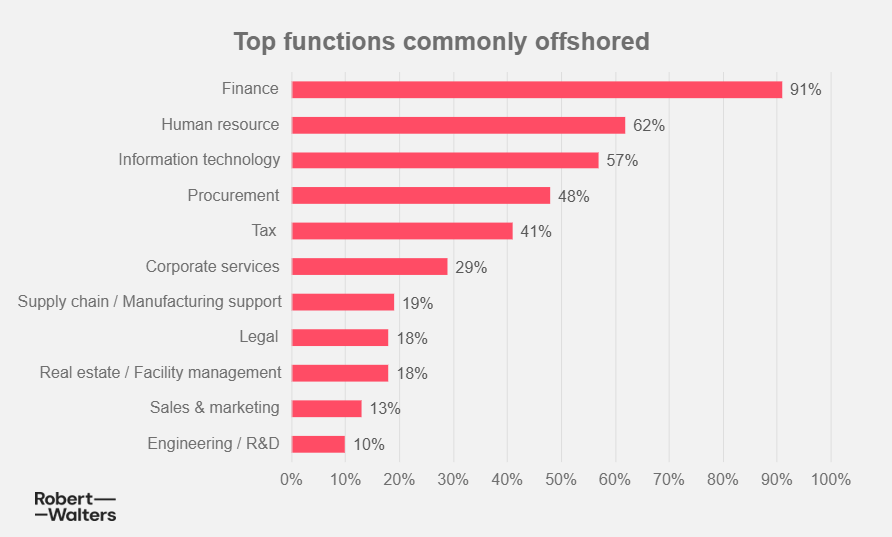
According to our Market Intelligence team, finance, HR, and IT are often among the first functions businesses offshore, with finance at 91%, HR at 62%, and IT at 57%. Procurement and tax also feature prominently at 48% and 41%, showing that offshore models now support a broader range of core business functions. At the same time, the model is evolving, with more value-add and client-facing roles moving offshore as organisations build broader capability over time.
Why financial services firms are exploring global capability centres (GCC) in APAC
For financial services firms, a GCC is rarely just an operational decision. It is usually a response to a combination of business pressures, including specialist talent shortages, rising delivery demands, and the need for greater resilience across critical functions.
For firms exploring APAC, the region is not simply an offshore destination. It is a place where capability can be built with greater depth and flexibility. Several markets in the region now offer established talent pools, experience in supporting global financial services operations, and the infrastructure needed to support more mature offshore models.
India, the Philippines, and Malaysia each bring different strengths to that decision. India is often associated with scale and specialist capability, the Philippines with service-led and operational support, and Malaysia with regional and multilingual capability. We explore each market in more detail below.
For businesses still assessing the opportunity, our offshoring talent e-guide offers a useful overview of the talent and location considerations shaping offshore growth in Asia.
India, the Philippines, and Malaysia: which market fits which need?
There is no single best location for every GCC. The right choice depends on the roles being hired, the scale required, the maturity of the local talent pool, and the long-term purpose of the centre.
GCC in India: scale and specialist capability
India remains one of the most established markets for GCCs and continues to attract firms looking for both scale and specialist expertise. It is particularly relevant for financial services organisations building teams across technology, analytics, finance, operations, and transformation.
Our Market Intelligence team’s data reinforces that position. India now has more than 1,580 GCCs nationwide, and 51% of GCC talent sits in STEM and digital roles across technology, banking, and financial sectors. For financial services firms, that signals a market with significant maturity and depth, especially where digital capability and specialist hiring are priorities.
India can be well suited to organisations looking to build sizeable teams or access more developed pools of technical and functional expertise. At the same time, competition for in-demand talent can be intense, which makes hiring strategy, employer positioning, and market intelligence especially important.
GCC in the Philippines: service-led and operational strength
The Philippines remains a highly relevant market for firms building customer-facing and operational support functions offshore. It is especially well established in areas where communication, service quality, and workforce adaptability matter, including customer support, insurance operations, finance operations, and broader back-office services.
For many firms, one of the clearest advantages is workforce alignment. Our Market Intelligence team highlights 97% English proficiency, alongside growing digital and technology capabilities in areas such as AI, data, and cloud. That makes the market attractive not only for traditional service-led roles, but also for businesses looking to expand into broader capability over time.
For organisations considering the Philippines, the opportunity often lies in building teams that combine strong service delivery with a positive employee and customer experience.
GCC in Malaysia: a strategic option for regional and multilingual capability
Malaysia is sometimes less discussed than India or the Philippines, but it can be a strong option for financial services firms looking for regional support, multilingual capability, and a more diversified APAC footprint. It is often attractive for shared services, finance, operations, and selected specialist support functions.
Our Market Intelligence team points to several strengths behind that appeal, including strong English proficiency, a multilingual workforce, and deep finance and accounting expertise. For financial services firms, that can make Malaysia particularly relevant where regional service delivery, stakeholder communication, and finance capability all matter.
For organisations assessing long-term scale in Asia, Malaysia can offer a useful balance of workforce quality, business environment, and regional connectivity. It may not always provide the same volume as India in every function, but it can be highly effective for firms prioritising stability, quality, and broader APAC relevance.
What financial services leaders should assess before setting up a global capability centre (GCC) in APAC
Location matters, but workforce design matters just as much. Businesses often focus first on where to build before fully clarifying which roles should sit in the centre, what success looks like, and what type of talent model is needed to support growth.
Before jumping into location strategy when planning your offshoring journey, care must first be placed on ensuring your service evolution and process optimisation are ready for the move. If something is already broken, you cannot expect it to work elsewhere.”
— Hazel Lancashire, Managing Director, Global Client Success
A few questions worth addressing:
- Which functions are best suited to a global capability centre model?
- Which roles require scale, and which require specialist expertise?
- What leadership capability is needed on the ground?
- How competitive is the local market for these skill sets?
- What employee value proposition will help attract and retain talent?
- How will hiring quality be maintained as the centre grows?
For banking, insurance, and financial services firms, these are not just hiring questions. They are business-critical questions that can affect service quality, continuity, governance, and long-term team performance.
Hiring at pace without a clear workforce strategy can create downstream issues, from skill gaps and attrition to inconsistent delivery standards. A stronger approach starts with realistic role planning, market insight, and a clear understanding of how offshore hiring supports the wider business.
Global capability centres are ultimately a talent decision
A global capability centre can help financial services firms build a more scalable and resilient operating model, but the model only works if the talent strategy is right.
India, the Philippines, and Malaysia each offer distinct advantages for organisations building in APAC. The right choice depends on the functions being moved, the skills required, and the long-term goals of the business. The most effective global capability centres are not built around cost alone. They are built around capability, talent access, hiring quality, and the ability to scale with confidence.
If your organisation is exploring a global capability centre in APAC, Robert Walters can help you assess the talent landscape, understand local hiring conditions, and shape an offshoring approach that supports your growth goals. Learn more about our offshoring talent solutions here.
Related content
View All
Nearshore vs offshore outsourcing For organisations considering an outsourcing move, the choice between nearshore and offshore will shape how they hire, where they build capability, and what their workforce looks like over the next decade. Both models extend access to talent beyond the home market.
Read More
Employee referral programmes are a CHRO’s dream. When executed well, they deliver hires 15 days quicker on average, boast a 4x higher success rate than traditional channels, and improve retention by up to 70%. Financially, they look beautiful on paper, slashing costs-per-hire by up to £6,000. With s
Read More
What is a shared service centre? A shared service centre (SSC) is a centralised business unit that delivers common operational functions, such as finance, HR, IT, compliance, and customer operations, across multiple parts of an organisation. Rather than duplicating these activities in every market o
Read More-
Is a global capability centre the same as a shared service centre?
Not always. A shared service centre is usually focused on centralising repeatable internal processes such as payroll, finance administration, procurement, or HR operations. A global capability centre may include those same activities, but it is often broader in scope and more strategic in purpose. Many GCCs support specialist functions, transformation work, digital delivery, analytics, or risk and compliance. In practical terms, a shared service center is often designed around efficiency, while a GCC is more likely to be designed around capability, control, and long-term business value. -
Why financial services firms are building global capability centres in APAC?
Financial services firms are increasingly using GCCs in APAC to access specialist talent, build more scalable delivery models, and improve resilience across key business functions. Cost can still be part of the equation, but it is rarely the only driver. Many firms are looking for better access to skills in technology, analytics, finance, operations, risk, and customer support. APAC markets also offer established talent pools and experience supporting global business operations, which makes the region attractive for organisations looking to build capability with more structure and long-term control. -
Which APAC countries are most commonly considered for a global capability centre?
India and the Philippines are often among the first markets considered, with Malaysia also becoming an increasingly important option depending on the business need. India is often attractive for scale and specialist capability, particularly in technology, analytics, and transformation. The Philippines is well established for customer-facing and operational support roles, especially where communication and service quality are important. Malaysia can be a strong fit for regional support, multilingual capability, and finance-related functions. The right choice depends less on popularity and more on the mix of roles, language needs, and long-term goals. -
What should companies assess before setting up a global capability centre?
Before setting up a GCC, companies should assess more than just location and cost. They need to understand talent availability, competition for key skill sets, leadership requirements, retention risks, and how the center will support wider business goals. It is also important to decide which functions are best suited to the model and whether the priority is efficiency, specialist capability, or long-term scale. For financial services firms in particular, governance, service quality, and continuity need to be considered early. A clearer workforce plan usually leads to a more sustainable and effective GCC build. -
How can companies scale hiring for a global capability centre?
Scaling hiring for a GCC requires more than filling roles quickly. Organisations need a clear view of talent availability, role prioritisation, and candidate demand in the local market. The hiring model also needs to reflect the mix of leadership, specialist, and volume roles being built. Without that structure, companies can struggle with inconsistent quality, slower delivery, or avoidable attrition. For businesses hiring at pace, a more structured approach such as project-based recruitment support can help maintain consistency while improving visibility across hiring activity, workforce planning, and long-term talent needs.